Frank Sinatra always talked about how he was one of the last living singers of Saloon Songs. I think he meant songs with a honkey-tonk flavor and a certain inebriated view on the world. I personally define “Saloon Song” to mean any song whose lyric specifically places the singer in a saloon (a bar will do just fine). Examples include: “One for my baby (and one more for the road”, “Angel Eyes”, and, um… others.
Here’s my crack at the genre:
Hey there,
You at the bar,
Pour me another… one of these
‘Cause I’m in the mood to remember
The night when my man went away.
Well, I guess you’d have called him a drifter,
He just drifted right into my heart,
There was never much to him,
No good to pursue him
So why then did I ever start?
Hey there, so how ‘bout that drink?
I’ve got another verse to sing
About a cool autumn night in September,
The night when I first met my man,
He was a liar, a cheat, and a scoundrel,
But I had so little to lose,
I thought I could right him, refine, and delight him,
The night when I first hatched my plan.
Oh how I tried so to keep him from trouble,
But I couldn’t keep trouble from him,
‘Cause when trouble’s a mind to, it always will find you,
Like the night when I first met my man.
Well, I guess you’ve have called him a bastard,
Well I guess I’d have called him one too.
But when you’ve tried hard to hone him,
You feel like you own him,
And love is the cost that’s come due.
And on the night when he finally left me,
The law picked him up in a fray,
So that was his way out, and I lost my payout,
The night when my man went away.
So I’ll think of him when I feel lonely,
And I’ll think of him when I feel blue,
But I’ll never regret that I once cast a bet on
The best damned man I ever knew.
Hey there,
The sun’s comin’ up.
It’s gonna be a bright and fine day.
But oh, how the moon was an ember,
The night when my man went away.
I’ve kind of been stalking the Chicago Symphony recently. Put another way, the orchestra has recently held three free events to open up their season, and I’ve been to all of them. Two of them were hits – out of the ballpark we’re talking here – and one was a miss.
Thursday, Sept 16
Mexico 2010 celebrations
Benito Juarez High School Auditorium
Carlos Miguel Prieto, conductor
This event was part of the CSO’s contribution to Mexico’s bicentennial celebration, and important collaboration and outreach event given the large Mexican community in Chicago and given the fact that Chicago is a sister city with Mexico City. The programming was awfully clunky though – why did it begin with “Till Eulenspiegel”? Why not just, you know, Mexican music? That’s what followed, namely Galindo’s “Sonnes de Mariachi”, Marquez’ “Danzon No. 2” and Moncayo’s “Huapango”.
Let’s forget this German oddball pink elephant gargantuatron in the room for a moment (which I’m guessing might have been the idea of the conductor who wanted to get something juicy into a rare appearance with the Chicago Symphony) and look at the Mexican selections. I happen to have played all three of those pieces in orchestras at one point or another. I’ve also played really, really good Mexican music. If you were going to play Mexican music for an inter-generational, celebratory crowd, how could you possibly avoid doing Sensemayá, which is one of the baddest pieces of orchestral music Mexican or otherwise out there?
I’m basically just shocked that there was not a single piece by Ravueltas (above) or Carlos Chavez, who are justifiably considered Mexico’s great composers. I also hate to rag on this concert because it did seem to deeply affect the community in attendance – young and old, Hispanic and non-, all seemed genuinely moved that their new auditorium would be graced by the presence of this great orchestra, and that’s a good thing.
Sunday, Sept 19
Free Concert for Chicago
Millennium Park
Riccardo Muti, conductor
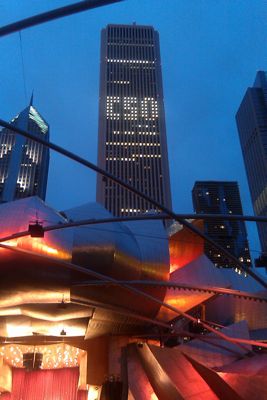
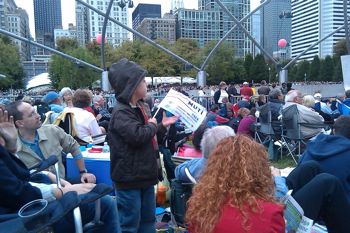
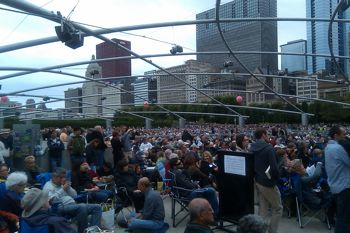
Anyway, I’ve got to hand it to Muti – this is a hell of a way to kick off a season. Great mix of a familiar classic and something crazy. New York should be green with envy. Their opening concert sounds like it SUCKED!!!!
[I should mention before we go any further that the audio from this particular concert is available for only another 12 hours (i.e. you won’t be able to listen to it after Friday morning.)Â Sorry!]
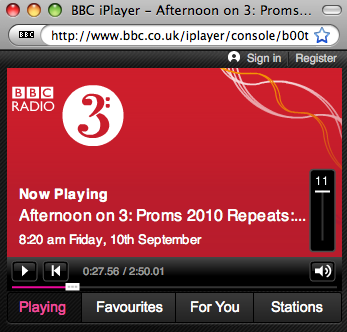
I think this is really a hell of a program, and certainly an interesting choice for a Prom, given that those programs usually tend toward the populist side of things. But first off, if you end up listening to one of the Proms broadcasts on the BBC iPlayer, you’ll notice something a tad peculiar about the volume adjuster. This has got to be a joke, right?
My analytical juices started to flow when Sir Simon mentioned in his introductory remarks that the Parsifal Overture was in many ways the most rhythmically complicated piece on the program. This seemed like it might be kind of a stretch particularly because when you listen to it, it sounds like pure, unfettered melody with a subtle oscillation running underneath (like around 0:44).
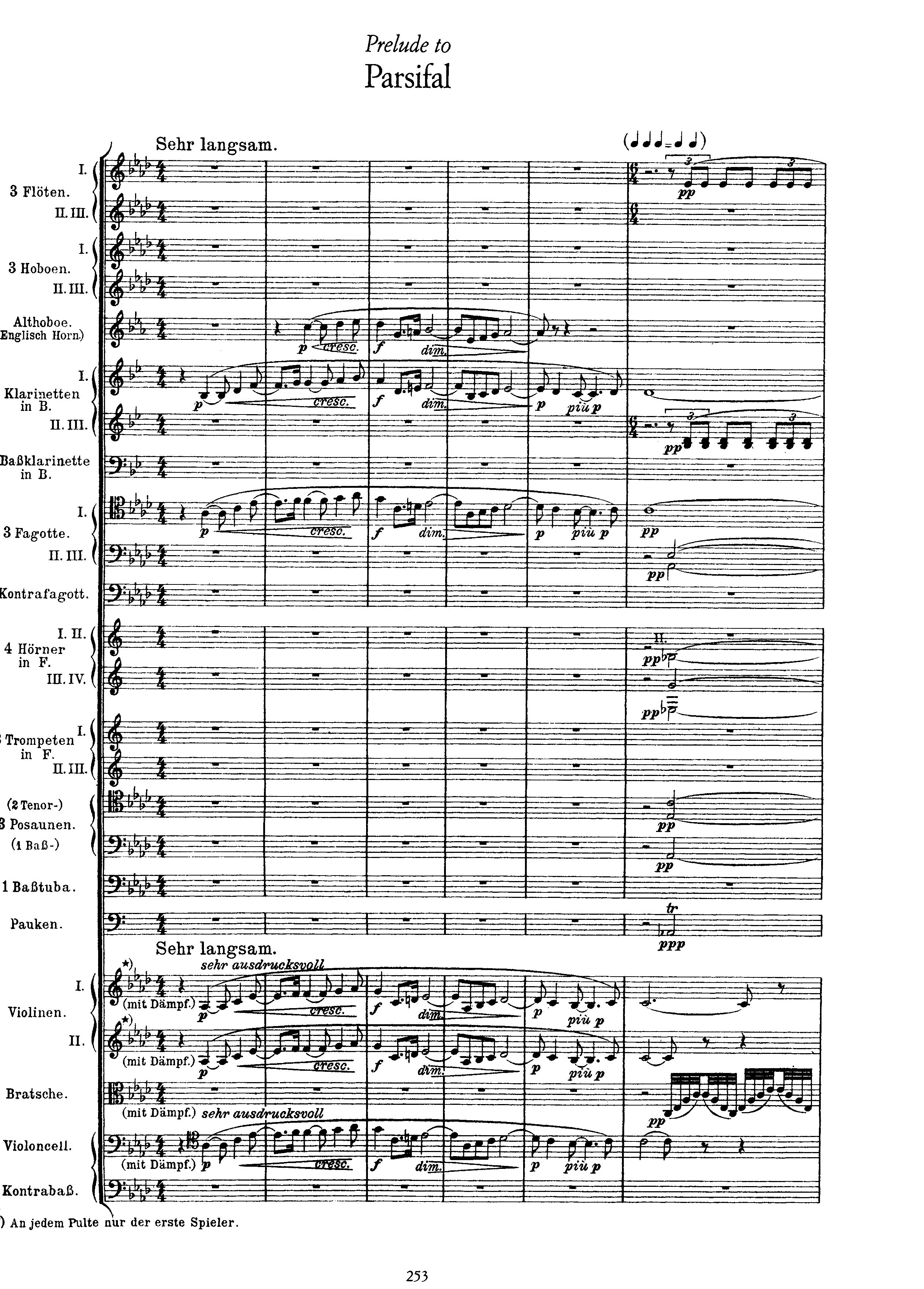
But not being familiar with the Overture (or is it a Prelude?) myself, I decided to take a look at the score:
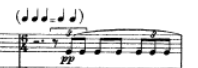
So now things start to get very interesting, because if you look at the flute part in the last bar, you see this:
which is one of these musical-mathematical conundra that conductors just love to stew over. See, what happens is that while the rest of the orchestra keeps playing in 4/4 – i.e. four quarter notes per measure – the flutes and two of the clarinets have to count 6 quarter notes to each measure. So, each of their quarter notes will end up being shorter/faster than the other players’ at a ratio of 6:4.
It would be easy enough if all they had to do was play 6 of their shorter, faster quarter notes against a conductor beating a four pattern of slightly slower quarter notes – musicians have to do this basic sort of trick all the time. But Wagner doesn’t make it that easy. Instead, he writes a rather complicated rhythmic figure (which, vexingly, will hardly even be heard in the orchestral texture.)
In this figure, the flutes and clarinets have to subdivide each of their six quarters into three triplet-eighth notes, so the total number of these notes in a bar is 6 x 3 = 18. This is all well and good, lest we forget that their visual and musical reference in lining up with the rest of the orchestra is 4 (quarter notes to the measure, that is). 18 ÷ 4 = 4.5. Since 4.5 isn’t a whole number, it’s not exactly useful.
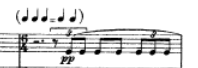
Except that a particularly clever flautist bent on finding a practical solution to this problem (the problem being how to know how fast to play her triplet-eighth notes in a bar of six and line that up with the conductor’s four pattern) might notice something: despite the fact that 4.5 seems to bear little logical relevance to the problem at hand, if we take a closer look at the particular rhythm that she’s playing:
we notice that the second beat in this pattern consists of 2 eighth notes. So, one solution is to approximate the triplets and make sure that the second eighth lands on the conductor’s fourth beat. 1 eighth note = 1.5 of the triplets; therefore 3 triplets + 1 eighth equals 4.5 triplets.
And that’s likely what everyone who actually plays this does, but the University of Chicagoan in me just hast to know the exact, theoretical answer, as practically untenable a solution as it may present. The next step is to multiply the 18 triplet-eighth notes by 2 – basically, we’re looking for a least common multiple between 18 and 4, i.e. 36.
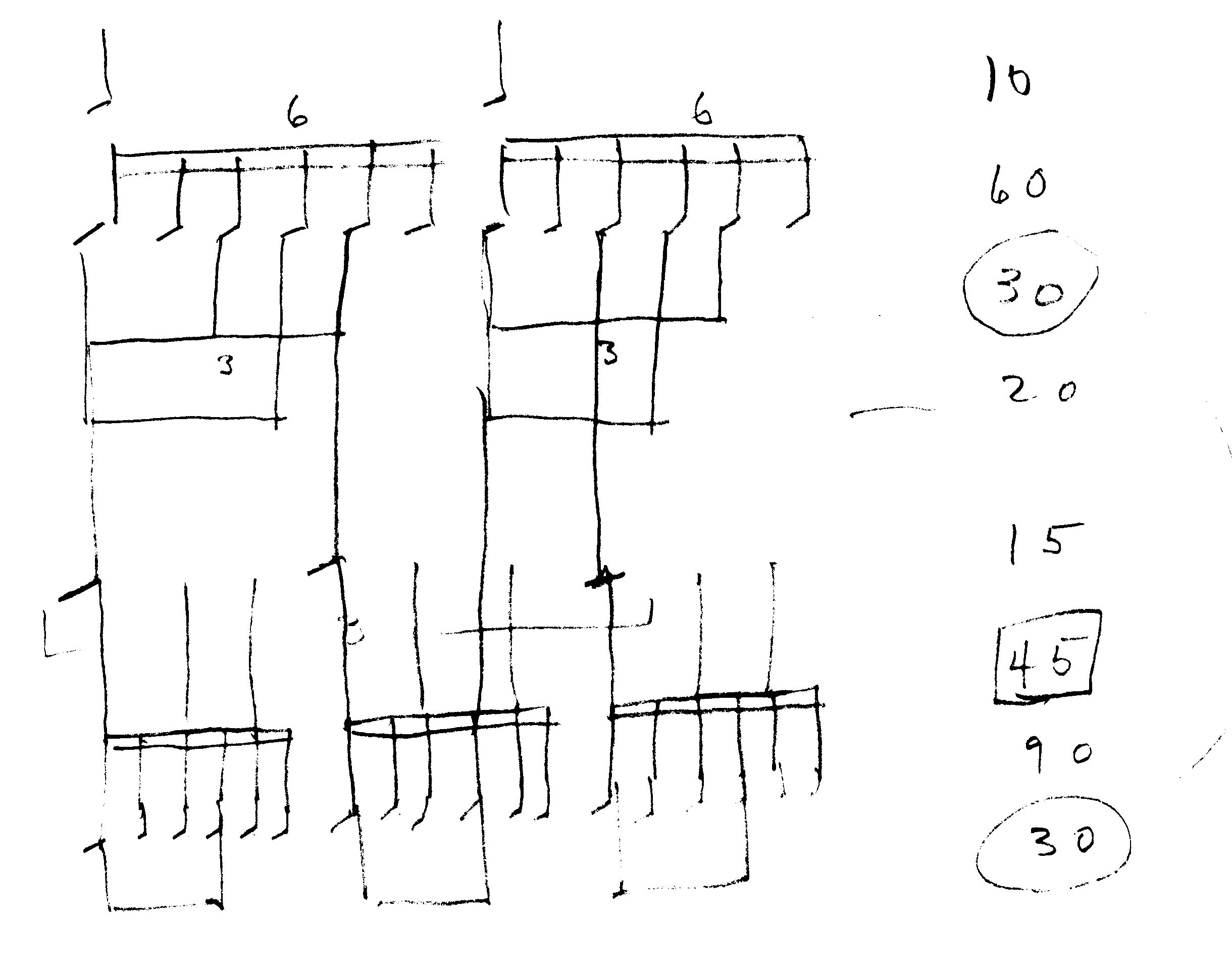
So then, the really anal-retentive flautist, who probably has no job and definitely has like zero friends, if she were hired to play the Parsifal Overture (Prelude?) would sit at home and practice counting 36 notes per bar (that’s 9 notes per beat, btw), and regroup those 36-lets into twos so that she would wind up with 18 groups of 2 and divide those 18 groups by 3 so that she could feel 6 beats per bar and know that she had done a really thorough job. She might employ a chart that looked something like this:
and still not be quite satisfied with the outcome. Now, if she really got to thinking smart, said flautist might decide to trip the conductor before he went on stage and step in for him, since beating a simple four pattern and letting everyone else worry about this crap is a way better idea. But she wouldn’t be able to escape her obsession – her obsession with rhythm. And now it would just get even worse, because did you see what was going on with those violas?? They play 8 notes to the beat, multiplied by 4 beats to the bar, so 24 notes in total per measure. Now our valiant flautist/conductor must find the least common multiple of 24 and 36 (it’s 72) if she wanted to figure out how the flute and viola parts really lined up.
I wonder if any conductor or musicologist or whoever has ever actually taken the time to figure out how these two parts line up by dividing the bar into 72 parts. I can only think of one conductor who I would even remotely suspicion of doing such a thing [who shall remain nameless.]
NEXT TIME: I rate Schoenberg, Webern and Berg. [Which I actually meant to do this time, but it seemed like things were getting a little intense already.] Somebody had to do it.
Does the thought of a middle-aged North German woman’s violin bow thrusting out into your face fill your little heart with glee? Well then you’re in luck, because the Berlin Phil is now in 3D! And you can even watch it in 3D on your computer, if you click on the links at the bottom of that page and then you are able to figure out how to activate the software (maybe it’s a PC thing?) and of course, if you have the proper eyeware.
Dare I admit that this development hardly came as a surprise to me? Well, it didn’t. Avatar may have announced the arrival of this revitalized technology, but there was another summer blockbuster that confirmed it was here to stay: Step Up 3D.
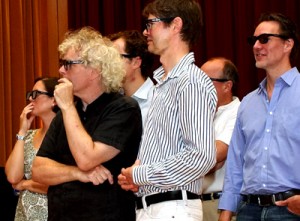
I recently took in a screening of this third installment of the Step Up triptych with these threeotherdudes. Not having seen the previous two films, I was worried that I would be hopelessly adrift when it came to the plot. Not so.  The writers were extremely generous in the pains they took rendering the story’s exposition crystal clear. And the third dimension made up for everything else.
In all seriousness, I do predict that the Met will be the next to jump on the 3D bandwagon. What exactly these organizations think they have to gain from going 3D is a little bit beyond me though – in fact, I already find the HD Met broadcasts a tad frightening in their intimacy… 3D threatens to go well over the line.
The other trendy new orchestra thing seems to be these season trailers. Witness:
[bt-dubbs, is it like, embarrassing that they both chose Sibelius symphonies as their theme music for the present season? At least it wasn’t the same symphony… would be a little like showing up to a party wearing the same dress, Ã la Lucy and Ethel or Dorothy and Blanche?]
In fact, the Baltimore Symphony is even doing this weird thing wherein they present a concert of individual movements of the season’s highlights. Interesting, isn’t it, that this modern idea ends up closer akin to what an orchestra concert used to look like 150 years ago…
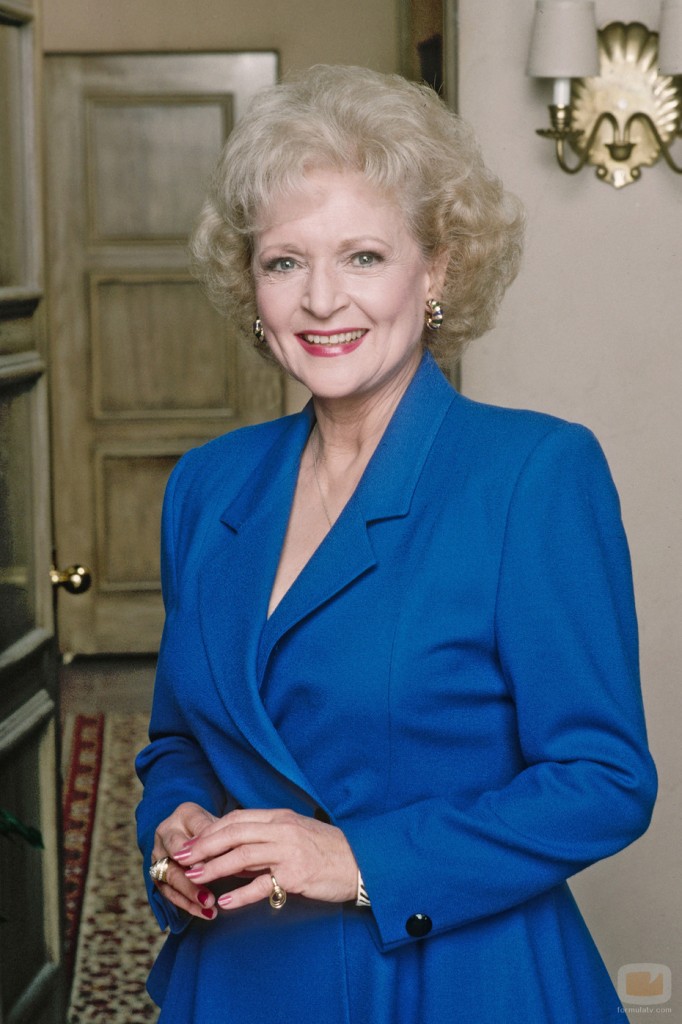
OK, can someone please explain this sudden burst of cultural currency afforded to Betty White? Don’t get me wrong – I’ve got no beef with said popularity resurgence, quite to the contrary. B-dubbs and I go back – way back – to the days of Sue Ann Nivens on MTM (not to be confused with MTT) and her work on the Golden Girls informed my childhood, youth, and young adulthood (to which I still desperately cling). I mean, come on, “Miami, you’re cuter than… an inter-uteran…” ?? That’s pure gold.
So, this is not meant as any kind of a criticism, just a statement of curiosity. For someone who has been intimately (well, not intimately) familiar with Betty’s work for so long, it comes as a sort of gratifying but confusing turn of events that she would gain so much in popularity after having gained so very much in age (she’s 88).
Am I wrong, or did it all start with the whole Facebook groundswell to get her to host Saturday Night Live? And what was that all about? Now she’s on the Emmy’s, has a whole bevy of guest appearances on other TV shows, and is even starring in her own sitcom on TVland?
Again, don’t get me wrong, I love the woman dearly, but it all just comes as a bit of a surprise? Anyone? Maybe Betty and the rest of the Girls made some kind of pact that the last one alive would harness the combined powers of the other three and ride the wave to a new brand of stardom… or was it that they would all have their heads frozen?


 )
)
 we notice that the second beat in this pattern consists of 2 eighth notes. So, one solution is to approximate the triplets and make sure that the second eighth lands on the conductor’s fourth beat. 1 eighth note = 1.5 of the triplets; therefore 3 triplets + 1 eighth equals 4.5 triplets.